
Table of Contents
ToggleTable of Contents
Introduction
If you are a jewellery retailer, wholesaler, or brand owner sourcing lab-grown diamond jewellery, you have almost certainly encountered the terms CVD vs HPHT. Most of the content available explains these technologies as a science lesson: plasma chambers, gigapascal pressures, and crystal growth morphology. That information has its place, but it rarely answers the question that actually matters to your business: which technology should I be stocking, and how does this choice affect my brand, my margins, and my customers?
This guide is written specifically for B2B buyers. It translates the science into strategy, helping you understand how CVD vs HPHT diamonds manufacturing differences translate into real decisions around collection planning, retail pricing, customer positioning, and wholesale sourcing from India.
Why This Technology Choice Matters More Than You Think
Lab-grown diamonds manufactured through CVD and HPHT are both chemically, physically, and optically identical to natural diamonds. They share the same carbon crystal structure, the same hardness on the Mohs scale, and the same optical brilliance. To the naked eye, and often to standard gemological equipment, they are indistinguishable from mined diamonds. And yet, the manufacturing method behind each stone leaves distinct fingerprints that affect quality characteristics, colour grades, inclusion profiles, production costs, and, ultimately, the retail story you tell your customers.
For B2B buyers making bulk purchasing decisions, this is not an abstract distinction. The technology behind your wholesale diamond jewellery shapes everything from the IGI certification language on the grading report to the product positioning language on your showroom counter card. Understanding CVD and HPHT empowers you to make sourcing decisions that align your supply chain with your brand identity, rather than simply buying whatever a manufacturer happens to have in stock.
What Is HPHT Diamond Manufacturing?
How the HPHT Process Works
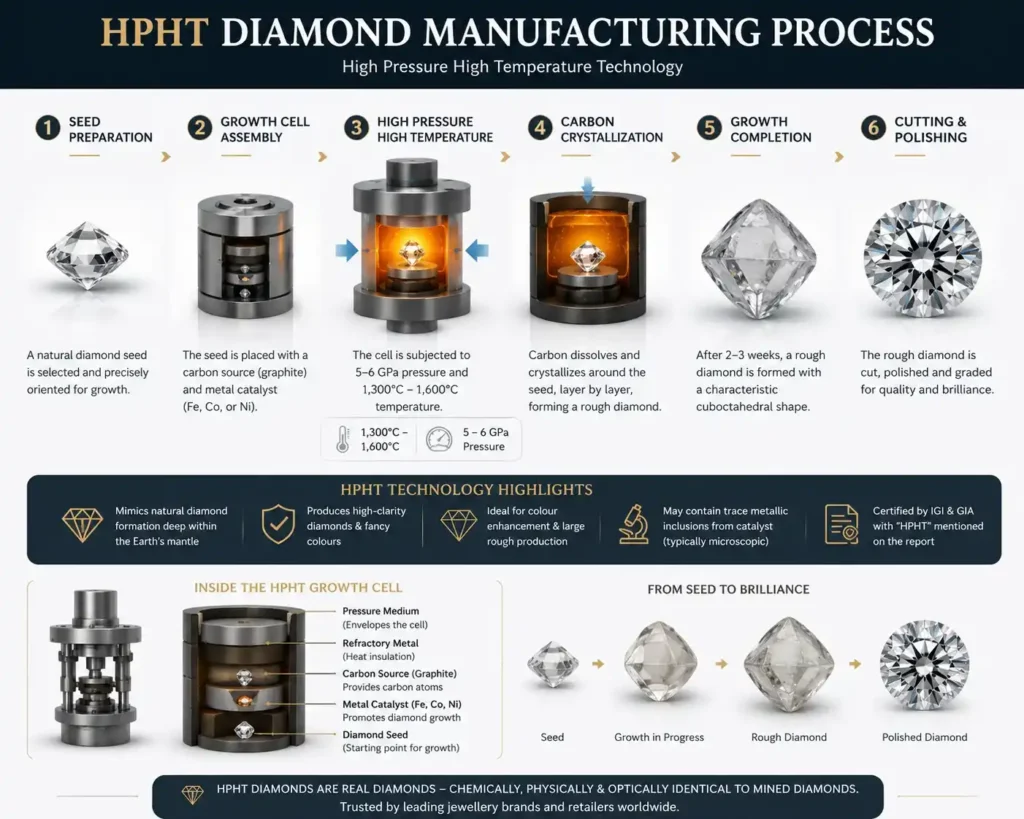
HPHT stands for High Pressure High Temperature. It is the original method of growing diamonds in a laboratory, first successfully achieved in the 1950s. The philosophy behind HPHT is replication; it mimics the extreme geological conditions found deep within the Earth’s mantle, where natural diamonds form over millions of years under immense heat and pressure.
In the HPHT process, a small diamond seed is placed inside a high-pressure growth chamber alongside a carbon source material, typically graphite, and a metal catalyst such as iron, cobalt, or nickel. The chamber is then subjected to temperatures between 1,300°C and 1,600°C and pressures exceeding 5 to 6 GPa, roughly equivalent to 870,000 pounds per square inch. Under these conditions, the carbon source melts and begins to crystallise around the diamond seed, growing outward over a period of two to three weeks until a rough diamond is formed.
The resulting crystal has a characteristic cuboctahedral shape, reflecting the multi-directional growth that occurs when carbon crystallises under uniform pressure from multiple angles simultaneously.
What HPHT Diamonds Mean for Your Display Case
For jewellery retailers and brand owners, HPHT diamonds have several characteristics worth understanding. They are particularly well-suited to producing high-clarity stones and fancy colour diamonds (including vivid yellows, blues, and pinks) because the controlled growth environment can accommodate precise chemical additions that produce consistent colour saturation. This makes HPHT a strong manufacturing method for premium bridal pieces, luxury solitaires, and statement jewellery where colour and rare appeal are central to the product story.
HPHT diamonds may occasionally contain trace metallic inclusions from the catalyst system used during growth. These inclusions, when present, are typically microscopic and do not affect the visual quality of the finished piece at retail level. GIA and IGI grading reports for HPHT diamonds will note the growth method, so your customers can see exactly what they are purchasing, which is increasingly valued as transparency becomes a competitive advantage in jewellery retail.
What Is CVD Diamond Manufacturing?
How the CVD Process Works
CVD stands for Chemical Vapor Deposition. It is a more recently developed method and represents a fundamentally different approach to diamond growth, one built on precision rather than brute force. Instead of replicating Earth’s extreme pressure, CVD uses gas chemistry in a controlled vacuum environment.
A thin diamond seed plate, often an HPHT-grown wafer, is placed inside a sealed chamber. The chamber is then filled with a carbon-rich gas mixture, typically methane and hydrogen, and subjected to temperatures around 700°C to 1,200°C, which is significantly lower than the HPHT process. Microwave energy is introduced to break down the gas molecules and create a plasma field. Freed carbon atoms then settle layer by layer onto the cooler diamond seed, gradually building up a diamond crystal over a growth period of two to six weeks, depending on the target size and quality grade.
The layer-by-layer growth mechanism produces diamonds with a characteristic plate-like internal structure, distinct from the radial sectors seen in HPHT stones. Importantly, CVD diamonds frequently achieve Type IIA classification, which is the purest form of diamond, with minimal to no nitrogen impurities. This classification is associated with exceptional optical transparency and colourlessness.
What CVD Diamonds Bring to Your Retail Collection
CVD diamonds are increasingly the preferred choice for jewellery manufacturers building large collections at consistent quality and colour grades. The process allows for exceptional control over the final stone’s characteristics, particularly in the D-to-F colour range that underpins most premium retail jewellery. The scalability of CVD manufacturing, where multiple growth chambers can run simultaneously, also makes it well-suited to high-volume wholesale production. This is a direct advantage for retailers placing repeat bulk orders.
CVD diamonds may occasionally show a slight brownish or greyish tint immediately after growth, caused by structural defects in the crystal lattice. Post-growth annealing treatments effectively correct this, however, producing stones that grade at colourless or near-colourless levels. This treatment process is standard practice in the industry, and all reputable certification bodies, including IGI and GIA, document it on the grading report.
CVD vs HPHT: A Side-by-Side Comparison for B2B Buyers
Rather than a straightforward ranking of one technology over the other, the most useful way to understand CVD vs HPHT is through the lens of what each produces and what that means for your specific business.
Growth mechanism: HPHT replicates Earth’s mantle conditions using extreme pressure and heat. CVD builds diamonds atom by atom using carbon-rich gas chemistry in a vacuum chamber.
Colour output: HPHT excels at fancy colours, including vivid yellows, pinks, and blues, and can also produce colourless stones in the D-to-F range. CVD is particularly strong in the colourless to near-colourless range, making it ideal for white diamond jewellery collections.
Clarity profile: Both methods produce gem-quality diamonds across all clarity grades when properly controlled. HPHT may show occasional metallic micro-inclusions; CVD may show strain-related internal patterning. Neither is visibly apparent in finished jewellery at retail level.
Production scale: CVD is more scalable for high-volume output, making it better suited to large wholesale orders requiring consistent quality across hundreds or thousands of pieces. HPHT is better suited to smaller batches of premium or fancy-colour stones.
Pricing at wholesale level: CVD diamonds are generally more cost-effective to produce at scale, which can support stronger retail margins on modern collections. HPHT diamonds, particularly in fancy colours, command premium wholesale prices that reflect their rarity and production complexity.
Certification: Both CVD and HPHT diamonds are certified by GIA and IGI, with the growth method clearly stated on the grading report. This transparency protects both the retailer and the end customer.
Which Diamond Technology Is Right for Your Brand?
When HPHT Is the Stronger Choice
HPHT manufacturing is the better fit when your brand is positioned in the luxury, bridal, or premium gifting segments. The ability to produce vivid fancy colour diamonds, combined with the perception of a more natural growth environment, gives HPHT pieces a story that resonates with customers seeking something rare and emotionally significant. If your showroom serves buyers shopping for engagement rings, anniversary pieces, or heirloom-quality jewellery, HPHT diamonds support the premium narrative your customers respond to.
HPHT is also well-suited for brands building exclusive collections where unique colour saturation or individual stone character is central to the design concept.
When CVD Is the Stronger Choice
CVD manufacturing is the stronger choice when your priority is building a large, consistent, and fast-moving collection with strong retail margins. The technology’s scalability means you can replenish high-selling SKUs reliably, maintain uniformity across a ring or earring line, and offer competitive price points that attract modern, value-conscious buyers without compromising on quality or certification.
CVD is particularly well-matched to online jewellery retailers, multi-brand showrooms, and export buyers building catalogue-based businesses where range depth, pricing flexibility, and consistent supply are non-negotiable.
Certification and Quality Assurance: What Every Wholesale Buyer Must Verify
Regardless of whether you are sourcing CVD or HPHT diamonds, certification is the non-negotiable foundation of a credible wholesale buying decision. For the international market, IGI (International Gemological Institute) certification is the most widely accepted standard for lab-grown diamonds, covering cut, colour, clarity, carat weight, and growth method identification. GIA certification is equally respected and particularly valuable for luxury and export markets.
When evaluating a wholesale diamond jewellery manufacturer, always confirm that certification is available at the stone level for individually graded pieces, and that the manufacturer’s quality control processes include inspection checkpoints for stone setting security, finishing symmetry, and dimensional accuracy. A diamond can grade beautifully on paper and still be poorly set in the finished piece of jewellery. Both factors matter to your end customer.
Why India Leads the World in Both CVD and HPHT Diamond Jewellery Manufacturing
India’s dominance in the global diamond industry is not limited to natural diamond cutting and polishing. The country has become a world-leading hub for lab-grown diamond manufacturing, with a particularly strong concentration of both CVD and HPHT production facilities in Surat, Gujarat, the city that processes more diamonds by volume than anywhere else on Earth.
Surat’s lab-grown diamond manufacturing ecosystem benefits from decades of accumulated gemological expertise, a tightly integrated supply chain connecting rough material producers, growers, cutters, polishers, and finished jewellery manufacturers, and a skilled workforce that understands both the technical requirements of stone quality and the aesthetic demands of global jewellery markets. For B2B buyers sourcing wholesale lab-grown diamond jewellery, working with a Surat-based manufacturer means accessing this full depth of expertise through a single, structured partnership.
India’s export infrastructure for lab-grown diamond jewellery has also matured significantly, with established frameworks for hallmarking, IGI certification, customs documentation, and quality verification that make international procurement straightforward and compliant.
How Aurament Wholesale Gives Your Brand Access to Both Technologies
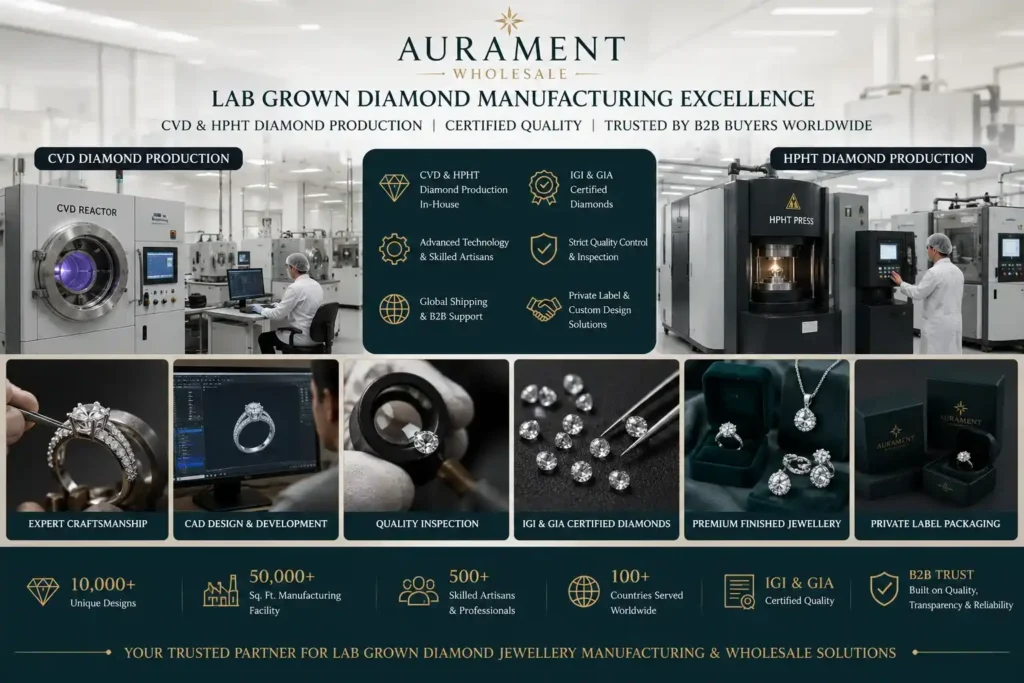
Aurament Wholesale is a certified diamond jewellery manufacturer based in Surat, India, offering B2B manufacturing support across both CVD and HPHT lab-grown diamond jewellery, as well as natural diamond collections. This dual capability is not merely a product catalogue feature; it is a genuine strategic advantage for brand owners who want to serve multiple customer segments without the complexity of managing multiple supply relationships.
For modern retail collections, fast-moving product lines, and export-ready catalogues, Aurament’s CVD diamond jewellery manufacturing delivers consistent colour grades, certified quality, and scalable bulk production. For premium bridal collections, luxury positioning, and bespoke private label pieces, HPHT diamond options support the higher-value narrative your customers expect.
Every piece manufactured at Aurament goes through a structured quality control process covering stone setting integrity, polish quality, symmetry, and finishing accuracy before dispatch. The in-house CAD design team supports custom collection development, and the white-label manufacturing programme ensures that everything produced can carry your brand’s identity, from the jewellery itself to the packaging it is presented in.
Whether you are a domestic wholesaler in Maharashtra or Gujarat, a retail chain expanding into premium collections, or an international export buyer building a lab-grown diamond brand, Aurament Wholesale offers a manufacturing partnership built around your growth. Explore the full range of women’s diamond jewellery collections and men’s diamond jewellery collections, or initiate a sourcing inquiry with the dedicated B2B team today.
You may also find these guides helpful: How to Choose a Reliable Diamond Jewellery Manufacturer and How to Find Trusted Wholesale Diamond Jewellery Suppliers.
Frequently Asked Questions
Neither technology is universally superior. CVD is better suited to high-volume, consistent collections in the colourless range, while HPHT is preferred for fancy colour diamonds and premium bridal pieces. The most effective wholesale strategy often involves using both technologies for different product lines within the same brand.
Yes. Both CVD and HPHT lab-grown diamonds are certified by GIA and IGI, with the growth method clearly documented on the grading report. IGI certification is the most widely accepted standard for lab-grown diamond jewellery in the wholesale and export market.
Yes. Aurament Wholesale supports full private label and OEM manufacturing using both CVD and HPHT lab-grown diamonds, including in-house CAD design, bulk production, and branded packaging tailored to your brand identity. Contact the team to discuss your specific requirements.
Reputable manufacturers will clearly state the growth method, whether CVD or HPHT, and provide IGI or GIA certification that documents it. If a manufacturer is vague about the growth method or cannot supply certification, treat this as a significant red flag before placing any order.
CVD diamonds are generally more cost-effective to produce at scale, making them more competitive for high-volume wholesale orders. HPHT diamonds, particularly in fancy colours, carry premium pricing that reflects their rarity and production complexity. Both offer strong retail margin potential when positioned correctly for the right customer segment.
Lorem ipsum dolor sit amet, consectetur adipiscing elit. Ut elit tellus, luctus nec ullamcorper mattis, pulvinar dapibus leo.