
Table of Contents
ToggleTable of Contents
Introduction
Every successful jewellery retail business is built on one thing that customers never see: the supply chain behind it. The quality of the pieces on your display, the consistency of your inventory, the margins that keep your business profitable, all of it flows from one foundational decision: who you source from. And in the diamond jewellery business, that decision is more consequential than in almost any other retail category.
The wholesale diamond jewellery market is vast, globally connected, and full of operators who are not what they present themselves to be. Retailers and buyers who approach supplier selection without a clear framework regularly end up with uncertified stones, inconsistent quality, inflated pricing, and supply relationships that fail when they are needed most.
This guide is built to change that. Whether you are a retailer stocking diamond jewellery for the first time, an established brand looking for a better manufacturing partner, or a bulk buyer scaling your supply chain, the seven criteria and practical evaluation process in this guide will help you find a wholesale diamond jewellery supplier worth trusting and avoid the ones who are not.
Why Your Choice of Wholesale Diamond Jewellery Supplier Is Your Most Important Business Decision
It is easy to underestimate how much a supplier relationship shapes a retail business from the inside out. But consider what a single unreliable wholesale source can cost you: a batch of diamond pieces with inconsistent finishing means customer complaints and returns. Uncertified stones discovered mid-sale mean lost trust that no marketing budget can recover. A supplier who misses delivery timelines means empty display cases during peak seasons, precisely when you cannot afford it.
Conversely, the right wholesale diamond jewellery supplier operates as a genuine business growth partner. Consistent quality means your customer experience is predictable and repeatable. Transparent pricing means your margins are calculable and plannable. Custom and private label capability means your product range is differentiated in a market where most retailers stock identical pieces from identical distributors. And a manufacturer who understands B2B supply, who staffs real support, maintains real timelines, and stands behind real quality control, is the infrastructure on which you can actually build a business.
This is why supplier evaluation deserves the same rigour you would apply to any other major business investment. The right framework makes that process efficient, systematic, and far more protective of your interests than any gut feeling alone.
Key Insight: In the diamond jewellery wholesale market, the quality of your product to your customer is only as good as the quality standards of the supplier you choose. There is no buffer, no workaround, and no amount of retail experience that compensates for a weak sourcing foundation.
Trader, Distributor, or Manufacturer: The Difference That Changes Everything
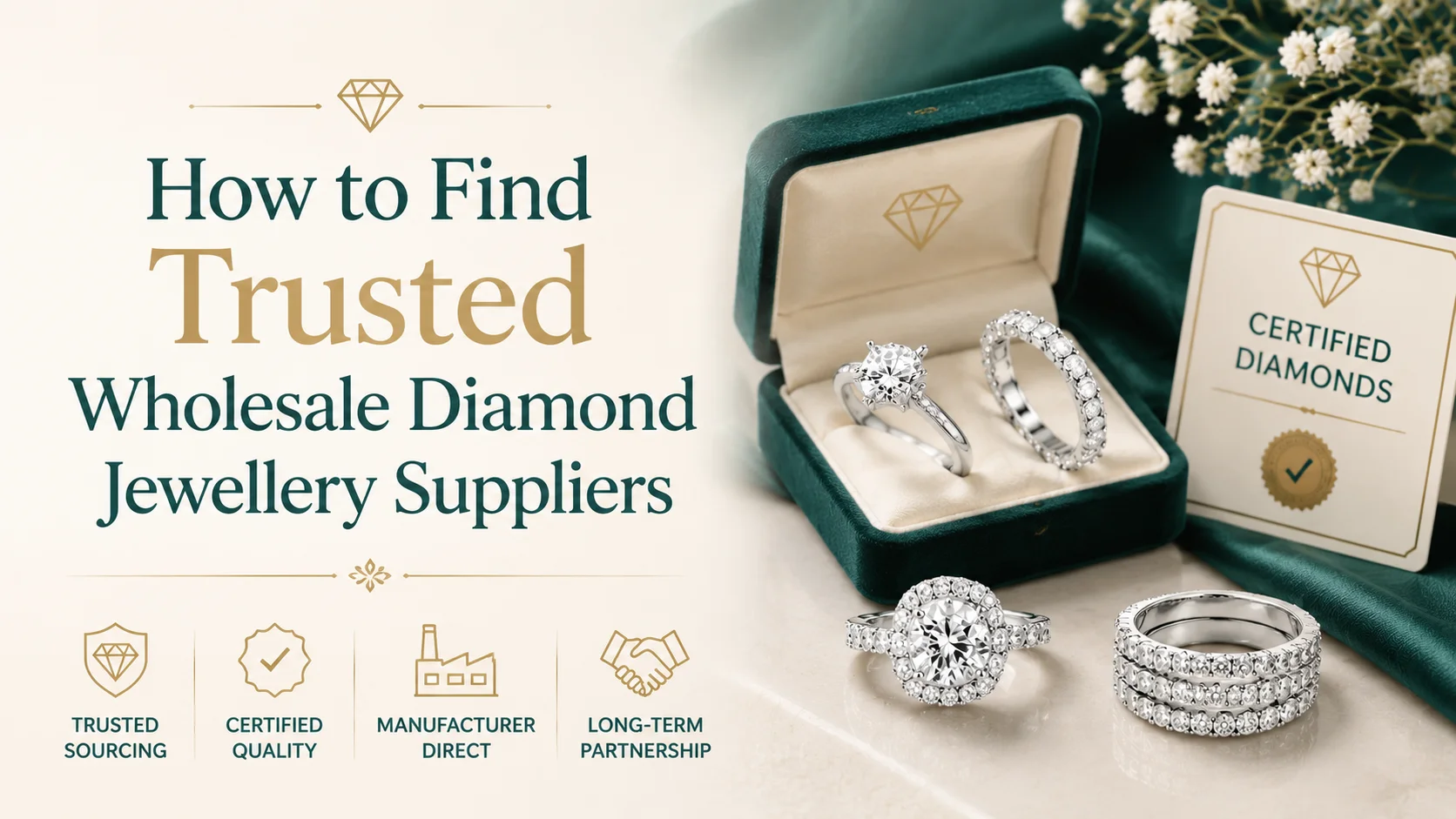
Before evaluating any wholesale diamond jewellery supplier, the most important question to ask is not about price or design range. It is this: who am I actually buying from? The answer to that question determines your cost structure, your quality control, your customization options, and your margin potential more than any other factor.
A trader purchases finished diamond jewellery from manufacturers or other traders and resells it to retailers. They add no value to the manufacturing process; they add only cost. Each layer of trading between the factory floor and your display case is a markup on a markup, compressing your margin before a single piece is sold. Traders often present themselves as suppliers or manufacturers, so the distinction is not always obvious from a website or a catalogue.
A distributor operates similarly to a trader but typically represents a portfolio of manufacturers within a region. Distributors provide logistics convenience and sometimes broader product range, but again, they are an intermediary layer with a margin of their own, and they have no ability to customize, modify, or quality-certify in any meaningful sense. If the manufacturer behind the distributor has quality issues, the distributor cannot fix them.
Why Buying Direct from a Manufacturer Wins for Retail Buyers
A direct manufacturer designs, produces, quality-controls, and ships diamond jewellery from their own facilities. When you source from a manufacturer directly, you eliminate every intermediary layer between the factory and your business. The cost savings are real and significant, often 20% to 50% compared to distributor-sourced equivalent product. But the benefits extend well beyond price.
A manufacturer can customize. They can work from your design specifications, produce pieces under your brand name, and incorporate your packaging standards, all capabilities that a trader or distributor simply cannot offer. A manufacturer can also troubleshoot. If a quality issue emerges, a genuine manufacturer has visibility into every stage of production and the capability to address it systematically. A trader can only pass the complaint back up the chain and hope.
For retailers and brands serious about building a differentiated, scalable jewellery business, manufacturer-direct sourcing is not a premium option. It is the only option that makes structural sense.
Retailer Rule: Always confirm whether the supplier you are evaluating actually manufactures their pieces, or whether they source from third parties and resell. Ask for facility details, production capabilities, and proof of in-house quality control. A genuine manufacturer will answer these questions without hesitation.
7 Criteria That Separate Trustworthy Wholesale Diamond Jewellery Suppliers from the Rest
1. Diamond Certification, The Absolute Foundation
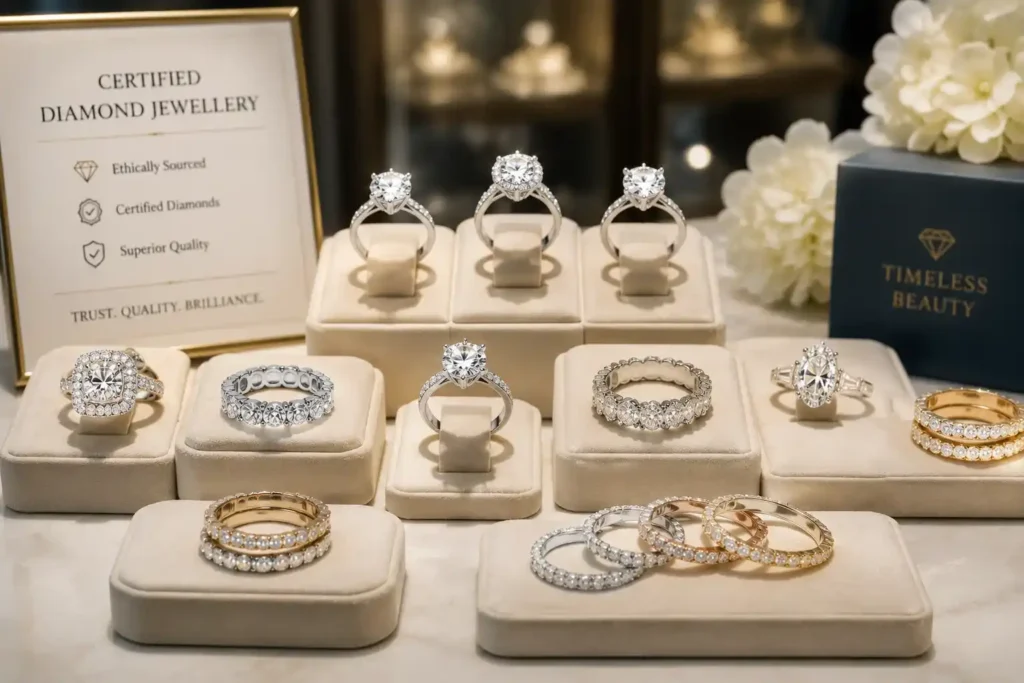
Certified diamonds are diamonds whose quality has been independently assessed and documented by a recognized gemological laboratory, GIA (Gemological Institute of America) or IGI (International Gemological Institute) being the two most respected globally. A wholesale diamond jewellery supplier who offers certification means every stone in every piece you stock is backed by an independent scientific assessment of its cut, colour, clarity, and carat weight.
For your retail business, this certification is both a quality assurance tool and a direct sales enabler. When a customer asks about the quality of the piece they are considering, you are not relying on your own word; you are presenting a certified document from an internationally recognized authority. That is the difference between a claim and a guarantee. Never source wholesale diamond jewellery from a supplier who cannot provide GIA or IGI documentation for their stones.
2. Verified Manufacturing Infrastructure
A legitimate diamond jewellery manufacturer will have documentable production infrastructure: in-house CAD design capability, a dedicated stone-setting team, polishing and finishing facilities, and a quality control department that operates as a distinct function within the manufacturing process. Ask specifically about these capabilities. Ask to see facility imagery or arrange a video walkthrough. A manufacturer confident in their operation will accommodate this without friction. One who deflects or becomes vague should be disqualified immediately.
3. Transparent, Itemized Pricing
Pricing in the wholesale diamond jewellery market should be fully transparent and itemized. You should know exactly what you are paying for: the metal type, the diamond grade and weight, the design complexity, and any finishing or certification costs. There should be no vague ‘package’ pricing that bundles unspecified components, and there should be no post-order surprises. A trustworthy wholesale supplier provides a clear, written price breakdown before you commit to an order, and stands by it.
4. Both Lab-Grown and Natural Diamond Capability
The wholesale diamond jewellery market in 2025 and beyond is decisively bifurcated between lab-grown and natural diamonds, and the most successful retailers carry both. A supplier who only works with one category is limiting your inventory strategy. A manufacturer who is equally fluent in lab-grown and natural diamond jewellery, and who maintains the same quality standards across both, gives you the flexibility to serve every segment of your customer base from a single, trusted sourcing relationship.
5. Custom Design and Private Label Support
Private label manufacturing is one of the most powerful margin and differentiation strategies available to independent jewellery retailers. The ability to have pieces produced to your design specifications and finished with your brand identity means your product is not available from any competitor, which is the foundation of genuine retail differentiation. Confirm that your wholesale supplier has CAD design capability, supports white-label production, and can incorporate branded packaging. Not all do. The ones who do are categorically more valuable partners.
6. A Documented Quality Control Process
Ask every supplier you evaluate to describe their quality control process, specifically. What does QC check at each stage? Who is responsible for it? What happens to a piece that does not pass? The answers to these questions reveal the operational maturity of the manufacturer. A supplier with a real, documented QC process can answer these questions in detail. One who gives vague, reassuring generalities about ‘caring about quality’ is telling you that no formal process exists.
7. Verifiable B2B Track Record
Red Flags to Watch For When Evaluating Wholesale Diamond Jewellery Suppliers
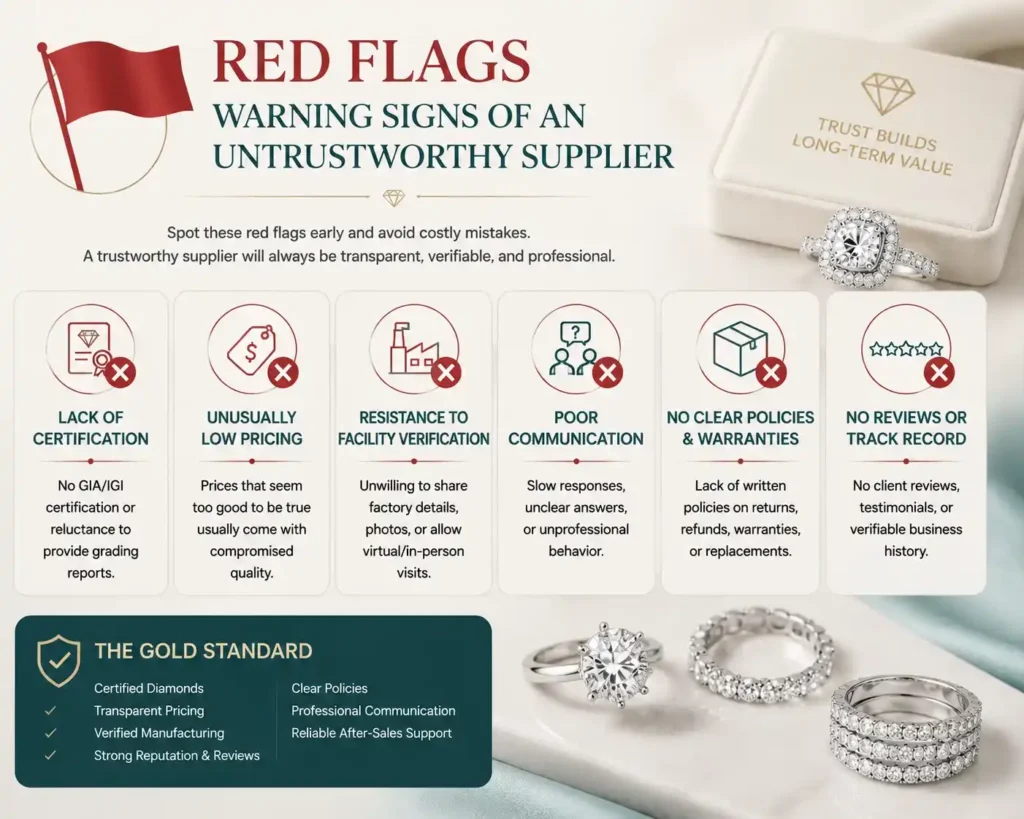
Beyond the positive criteria, knowing what warning signs look like is equally important. These are the signals that should cause a retailer to slow down or step back from a supplier relationship before it costs them.
- No certification documentation: If a supplier cannot provide GIA or IGI certificates for their diamonds, the stated grades are unverifiable. Do not accept the claim; require the documentation.
- Unusually low pricing that seems implausible: Wholesale diamond jewellery has a cost floor defined by the diamond market. Pricing significantly below market rates almost always indicates compromised stone grades, base metal substitution, or certification misrepresentation.
- Resistance to facility verification: A legitimate manufacturer is proud of their operation and transparent about it. A supplier who deflects requests for factory information or video walkthroughs is concealing something significant.
- No clear returns or dispute process: Reputable B2B suppliers have documented policies for quality disputes, returns, and replacements. A supplier with no clarity on this topic is telling you that disputes will be difficult to resolve in your favour.
- Vague or inconsistent communication: Slow response times, inconsistent information across contacts, and unclear ownership of your account are early indicators of the same chaos you will experience during order execution and post-sale support.
- Inability to provide existing client references: A supplier confident in their B2B track record can connect you with existing clients who will confirm their experience. One who cannot, or will not, has something to hide.
How to Evaluate a Wholesale Diamond Jewellery Supplier Before Your First Order
Knowing the criteria is one thing. Applying them in a structured evaluation process is what actually protects your business.
Begin with a detailed initial inquiry. Contact the supplier with a specific requirement, a particular ring category, metal type, diamond grade, and quantity estimate. How they respond tells you everything: Do they ask the right clarifying questions? Do they provide itemized pricing? Do they address certification proactively? The quality of a supplier’s first response is a reliable predictor of how they will perform throughout the relationship.
Request samples of the specific product categories you intend to stock. A legitimate wholesale manufacturer will accommodate sample requests, often with a sample fee that is credited against your first bulk order. When samples arrive, evaluate them not just visually but structurally. Check setting security under magnification. Inspect finishing quality across multiple pieces for consistency. Confirm that certification documentation accompanies every sample. Any inconsistency between the sample and the bulk order is a conversation to have before committing, and a trustworthy manufacturer will engage with that conversation honestly.
Before finalizing your first order, confirm all terms in writing: the exact specifications (design codes, metal type, diamond grades, quantities per style), delivery timelines, pricing including any shipping and duty components, and the process for quality disputes. A supplier who resists putting terms in writing is not a supplier you want managing your inventory.
Best Practice: Treat your first wholesale order as both a business transaction and a supplier audit. The care, transparency, and responsiveness you experience during that first order is exactly what you will get at scale, for better or worse.
Why India, and Surat Specifically, Is the World's Best Source for Wholesale Diamond Jewellery
If you are a retailer or brand owner who has not yet explored manufacturer-direct sourcing from India, you are operating at a structural cost disadvantage. India accounts for approximately 90% of the world’s cut and polished diamonds by volume, and Surat, Gujarat sits at the absolute centre of that ecosystem. The city’s manufacturing infrastructure, artisan depth, raw material access, and logistics network represent a concentration of diamond jewellery production capability that exists nowhere else on the planet.
For wholesale buyers globally, sourcing directly from a Surat-based manufacturer means accessing the supply chain at its source, before the compounding margins of international distributors, regional traders, and multi-tier intermediaries inflate the cost. The economics are real: certified diamond jewellery sourced manufacturer-direct from Surat regularly arrives at landed costs 20% to 50% below equivalent distributor-sourced product. That differential either becomes margin or it becomes competitive pricing power, both of which strengthen your business.
India’s diamond jewellery manufacturing sector also offers the deepest combination of traditional craftsmanship and modern production technology. CAD-designed settings, precision stone setting, and hand-finishing are available at scale in Surat in a way that cannot be replicated at equivalent cost in any other manufacturing region. For retailers who want both quality and scalability, this is the sourcing environment that delivers both.
Why Retailers and Brands Choose Aurament Wholesale as Their Diamond Jewellery Supplier
Aurament Wholesale is a certified diamond jewellery manufacturer based in Surat, Gujarat, at the heart of the world’s diamond manufacturing capital. They serve wholesalers, retailers, jewellery brands, and export buyers across India and internationally, with a manufacturing-direct model that eliminates every unnecessary layer between the factory and your business.
Every piece Aurament produces, whether lab-grown or natural diamond, women’s or men’s, is manufactured from certified diamonds, subjected to a rigorous multi-stage quality control process, and delivered with full documentation. Their in-house CAD design capability supports both catalogue-based bulk orders and fully custom design development for retailers and brands who want to differentiate their product offering through private label manufacturing.
Pricing at Aurament Wholesale is fully transparent. Before any order is placed, buyers receive clear, itemized pricing based on design, metal type, diamond specification, and quantity, with no hidden charges, no post-order surprises, and no pressure tactics. Their dedicated B2B support team manages every inquiry, order update, and reorder with the attention and continuity that multi-order retail relationships require.
Aurament serves dealers, wholesalers, distributors, retail chains, and export buyers across Maharashtra, Gujarat, Rajasthan, and growing international markets. Their model is built around long-term partnerships, which is why their existing partners return for repeat orders with the consistency that defines a genuinely healthy supply chain.
Ready to explore wholesale diamond jewellery with a manufacturer you can actually trust? Contact Aurament Wholesale at auramentwholesale.com or reach the team directly at info@aurament.com / +91 92749 15935.
Explore Aurament's Wholesale Diamond Jewellery Collections
Aurament Wholesale manufactures a comprehensive range of certified diamond jewellery for men and women, all available for bulk ordering, custom design, and private label production:
- Women’s Diamond Rings, Wholesale Collection, Solitaires, halo rings, eternity bands, and statement designs for retail buyers.
- Women’s Diamond Earrings, Wholesale Collection, Studs, drops, and hoops crafted for consistent retail sell-through.
- Women’s Diamond Necklaces, Wholesale Collection, Pendant sets, station necklaces, and layered designs for fashion and bridal buyers.
- Women’s Diamond Pendants, Wholesale Collection, Solitaire pendants, halo pendants, and custom pendant manufacturing.
- Women’s Diamond Bracelets, Wholesale Collection, Tennis bracelets, bangles, and chain bracelets for premium retail display.
- Men’s Diamond Jewellery, Wholesale Collection, Rings, bracelets, and chains in bold, architectural designs for men’s retail.
- Women’s Diamond Jewellery, Full Collection, Browse the complete women’s diamond jewellery manufacturing range.
- Men’s Diamond Jewellery, Full Collection, Explore the complete men’s diamond jewellery manufacturing range.
- About Aurament Wholesale, Our manufacturing story, Surat infrastructure, and credentials.
- Become a Partner, Start Your Wholesale Inquiry, Submit your requirement and begin your wholesale partnership.
Conclusion: The Right Wholesale Supplier Is the Foundation Your Jewellery Business Is Built On
Finding a trusted wholesale diamond jewellery supplier is not a task to approach casually or rush through. It is the sourcing decision that underpins everything visible in your retail business, the quality of the pieces your customers hold, the margins that sustain your operations, and the consistency that keeps your customers returning. Done well, it is a business asset. Done poorly, it is a business liability that compounds with every order.
The framework in this guide, seven criteria, a structured evaluation process, an understanding of the manufacturer-versus-trader distinction, and clear red flag awareness, gives you the foundation to make this decision with confidence and clarity. Apply it to every supplier you evaluate. And apply it especially when a supplier seems too good to be true, because in the wholesale diamond market, they almost always are.
Aurament Wholesale offers exactly what this framework demands: manufacturer-direct sourcing, GIA and IGI certified diamonds, transparent pricing, in-house CAD and private label capability, and a dedicated B2B support team, all from the heart of the world’s diamond manufacturing capital in Surat, Gujarat. If you are ready to build your jewellery business on a supply chain you can genuinely trust, the next step is one conversation away.
Frequently Asked Questions: Wholesale Diamond Jewellery
A wholesale supplier is a broad term that includes traders, distributors, and manufacturers. A manufacturer actually produces the jewellery in their own facilities. Sourcing directly from a manufacturer eliminates intermediary markups, gives you access to custom and private label capabilities, and provides direct accountability for quality control. For retailers serious about margins and product differentiation, manufacturer-direct sourcing is always the stronger choice.
Request GIA or IGI certification documentation for sample pieces before any order. Ask for facility information and production credentials. Look for verified Google reviews and ask for references from existing retail partners. A legitimate wholesale manufacturer will be fully transparent about their credentials, infrastructure, and pricing; any reluctance to share this information is a clear warning sign.
For natural diamonds, GIA certification is the global standard and the most universally recognized by consumers and retail markets worldwide. For lab-grown diamonds, IGI certification is the industry benchmark and is widely accepted across Indian and international retail markets. Both certifications provide an independent assessment of cut, colour, clarity, and carat weight, ensuring that what you pay for is exactly what you receive.
Yes, if the wholesale supplier is a genuine manufacturer with in-house CAD design capability. Custom and private label manufacturing allows you to produce pieces to your specifications, under your brand name, with your packaging, giving your retail range genuine differentiation. Confirm CAD capability, design development timelines, and minimum order quantities for custom pieces before committing.
India produces approximately 90% of the world’s cut and polished diamonds by volume, with Surat as the manufacturing epicentre. Sourcing manufacturer-direct from Surat eliminates the margin layers added by distributors and traders, typically delivering landed costs 20% to 50% lower than equivalent distributor-sourced product. Combined with India’s depth of craftsmanship, CAD capability, and scale of production, it is the most cost-effective and quality-consistent sourcing option available to retailers globally.
MOQ varies by manufacturer and product category. Reputable manufacturers like Aurament Wholesale offer flexible MOQ structures designed to support both new retail buyers testing a range and established brands placing large repeat orders. Contact the manufacturer directly with your specific category requirements and order volume to receive accurate MOQ and pricing information tailored to your business stage.