
Table of Contents
ToggleTable of Contents
Introduction
Diamond rings remain one of the most profitable jewellery categories for retailers, wholesalers, and private label brands. From engagement rings to daily-wear luxury designs, customer demand continues to grow across both natural and lab-grown diamond segments. For jewellery businesses, choosing the right diamond rings wholesale partner can help improve margins, maintain consistent quality, and build a stronger product range for modern buyers.
In the jewellery retail business, your margin lives or dies at the sourcing stage. And nowhere is that more consequential than in diamond rings wholesale, the single highest-demand, highest-margin category in any fine jewellery store. Yet most retailers are still sourcing diamond rings the expensive way: through middlemen, distributors, and multi-layered supply chains that eat into profit before a single ring reaches the display case.
The shift happening right now, and accelerating, is manufacturer-direct wholesale sourcing. Retailers, boutique jewellery brands, online sellers, and export buyers are bypassing intermediaries and going directly to certified diamond ring manufacturers in India to access better pricing, better design variety, better quality control, and crucially, the ability to customize.
This guide is for every retailer, bulk buyer, jewellery brand owner, and export professional looking to understand what certified diamond rings wholesale actually means, how to evaluate a manufacturer worth trusting, and why India, specifically Surat, is the sourcing destination that serious buyers are choosing in 2026 and beyond.
Why Diamond Rings Remain the Highest-Value Category for Retailers
Among all fine jewellery categories, necklaces, earrings, bracelets, pendants, diamond rings consistently deliver the strongest retail performance. They dominate two of the most emotionally driven purchase occasions in any culture: engagements and weddings. These are moments where buyers willingly invest significantly more than they might for any other jewellery type, and where product quality and certification are non-negotiable decision factors.
This is why many retailers treat diamond rings wholesale as a core buying category instead of a seasonal or occasional purchase.
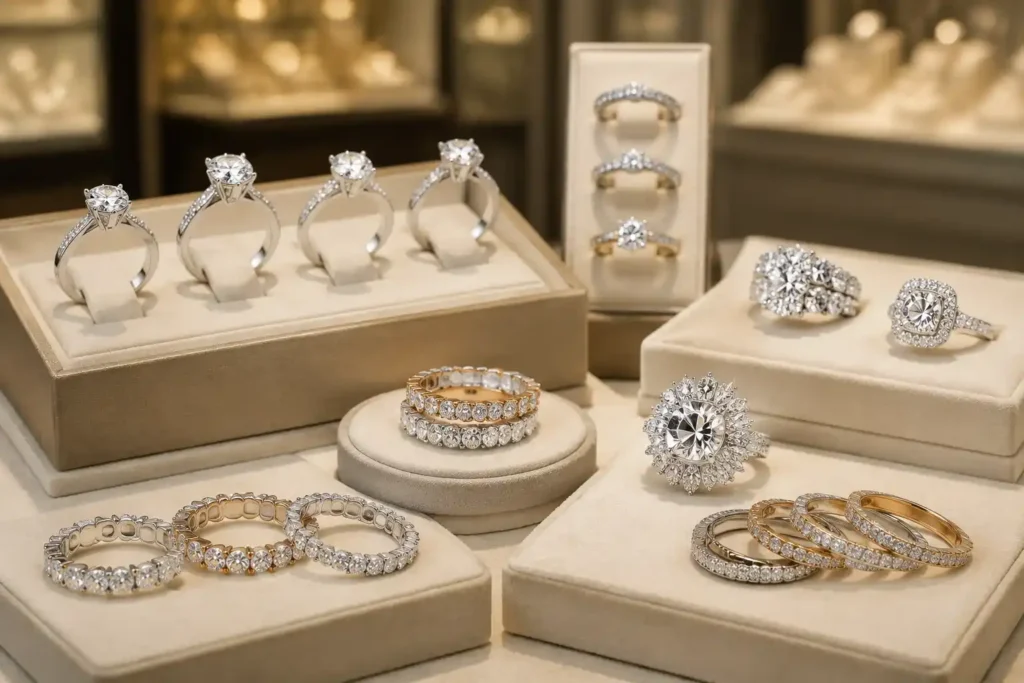
But diamond rings are not just bridal. Solitaire rings, eternity bands, stackable diamond rings, and statement cocktail rings have all grown strongly as self-purchase and gifting categories over the past five years. This expansion means that a retailer stocking a well-curated range of certified diamond rings has multiple customer segments to serve across price points, occasions, and design preferences, from a young professional buying their first fine jewellery piece to a couple celebrating a 25th anniversary.
For bulk buyers and multi-store retailers, this breadth of demand makes diamond rings wholesale the safest and most scalable inventory investment in fine jewellery. The key is sourcing the right designs, at the right certification standards, from a manufacturer who can deliver consistency at scale.
Industry Insight: India manufactures approximately 90% of the world’s cut and polished diamonds by volume, making it the undisputed global centre for diamond jewellery production, and the most cost-efficient sourcing destination for retailers worldwide.
What 'Certified' Actually Means in Diamond Rings Wholesale — And Why It Is Non-Negotiable for Retailers
The word ‘certified’ is used liberally in the jewellery industry, but its meaning matters enormously in a B2B wholesale context. When a wholesale diamond ring is described as certified, it should mean that the diamonds within that ring have been graded by an independent, internationally recognized gemological laboratory, and that grading report accompanies the piece as documentation of its quality.
For retailers, this certification is not just a quality assurance tool; it is a sales tool. When a customer asks about the quality of the diamond in the ring they are considering, being able to present a GIA or IGI certificate transforms that conversation. It replaces a salesperson’s claim with an independent scientific assessment. It builds trust, justifies the price point, and often closes the sale.
GIA vs IGI Certification: What Retailers Need to Know
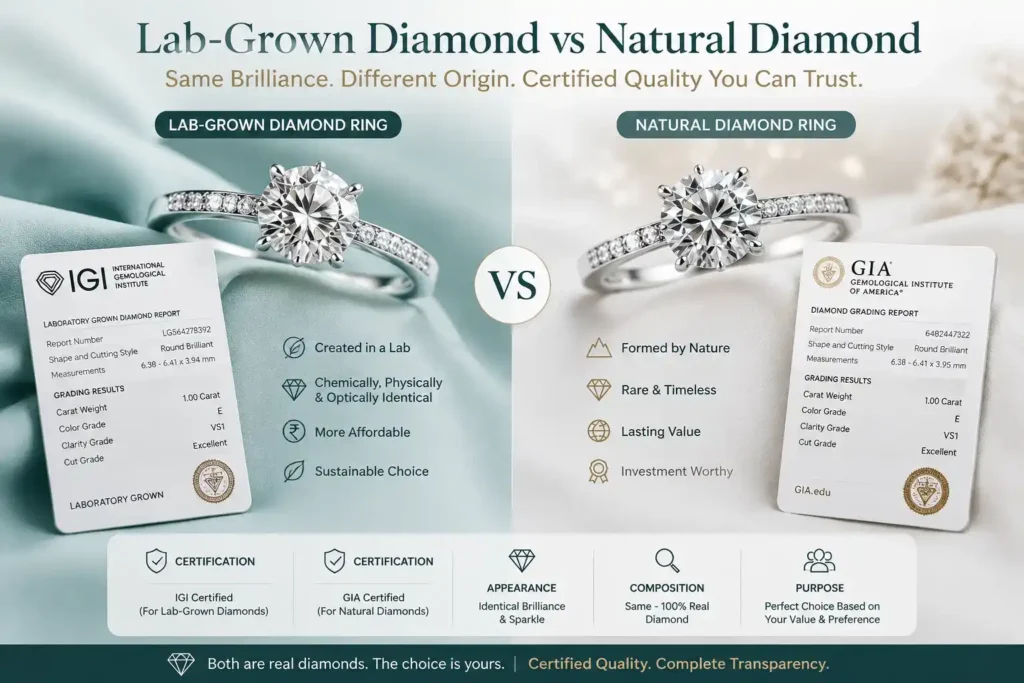
The Gemological Institute of America (GIA) is widely regarded as the most stringent and universally trusted diamond grading authority in the world. GIA certification is the gold standard for natural diamonds and carries strong recognition across global markets, making it particularly important for export buyers and premium-positioned retailers.
The International Gemological Institute (IGI) has become the dominant certification body for lab-grown diamonds globally, and its standards are well-respected across the Indian market and increasingly across international markets. For retailers building collections around lab-grown diamond rings, which offer significantly better margins, IGI-certified pieces are the industry benchmark.
A reputable wholesale diamond ring manufacturer will offer both options and will never ask you to accept stones without independent certification documentation. Transparency at this level is the baseline of a trustworthy B2B relationship.
Retailer Rule: Never place a wholesale order for diamond rings without receiving certification documentation for every stone. Any manufacturer unable or unwilling to provide this is a sourcing risk, not a sourcing partner.
Lab-Grown vs Natural Diamond Rings: A Practical Guide for Retail Buyers
One of the most important decisions a retailer makes when building their diamond ring inventory is where to position themselves on the lab-grown versus natural diamond spectrum. This is no longer a simple choice; it is a strategic one, and the right answer depends entirely on your customer base, your price positioning, and your growth trajectory.
Lab-Grown Diamond Rings for Wholesale Retail
Lab-grown diamonds are chemically, physically, and optically identical to natural diamonds. They are graded using the same 4C framework, cut, colour, clarity, and carat, and certified by the same independent laboratories. The critical difference, from a retailer’s perspective, is price. Lab-grown diamonds typically cost 40% to 70% less than comparable natural diamonds at the wholesale level, which creates substantially better retail margins without sacrificing the customer’s experience of a genuine, certified diamond.
For retailers targeting younger buyers, particularly women aged 22 to 35 who are style-driven and value-conscious, and for those stocking engagement rings at accessible price points, lab-grown diamond rings wholesale is the single most powerful tool in your inventory strategy right now. The market is growing rapidly. The market is growing rapidly, and retailers who build strong lab-grown collections today are positioning themselves ahead of where the majority of demand is heading.
Natural Diamond Rings for Wholesale Retail
Natural diamonds retain their position as the preferred choice for luxury retail, bridal collections, and markets where the emotional and cultural significance of a naturally formed stone matters to the buyer. In India especially, natural diamonds carry strong resonance in wedding jewellery and heritage gifting, and premium retail stores serving this segment benefit from the perception of higher value and greater rarity.
For retailers serving an older, more traditional demographic, high-net-worth clients, or export markets where natural diamonds carry premium cachet, maintaining a well-certified natural diamond ring collection is essential. The key is ensuring full GIA documentation and sourcing from a manufacturer with rigorous quality control on stone selection and setting.
Retailer Strategy: The most successful jewellery retailers today carry both lab-grown rings at accessible price points to attract younger and first-time buyers, and natural diamond rings for bridal, luxury, and gifting segments. Your wholesale manufacturer should be able to supply both with equal quality standards.
The Most In-Demand Diamond Ring Designs for Retail Inventory in 2025–2026
Knowing which diamond ring designs to stock is as important as knowing where to source them. Consumer demand in 2025 and 2026 has consolidated around a set of designs that deliver strong sell-through rates across demographics and occasions. Retailers and bulk buyers stocking these categories will find the fastest inventory movement and the strongest repeat purchase cycles.
The solitaire diamond ring remains the single most purchased fine jewellery item globally, driven by engagement and self-purchase demand. Its timeless simplicity means it never ages in the retail display, and in both lab-grown and natural diamond versions, it delivers consistent sell-through. The eternity band, a continuous row of diamonds set around a full or half circle, is the second most requested bridal and anniversary piece, and it layers well with both solitaires and fashion rings for the growing stacking trend.
Halo rings, where a central diamond is surrounded by a ring of smaller accent stones, deliver maximum visual impact for their price point, making them the strongest performer in the mid-market engagement ring segment. For fashion-forward retail floors, geometric and Art Deco-inspired designs in white gold and rose gold are driving strong interest among women aged 25 to 38, while men’s diamond rings in bold, architectural designs, signet styles, channel-set bands, and single-stone statement rings represent one of the fastest-growing expansion segments for retailers looking to capture the men’s fine jewellery market.
Bulk Buyer Tip: When placing wholesale orders, prioritize solitaires and eternity bands as your core stock, halo rings as your mid-market engagement driver, and a select range of fashion and men’s designs to capture emerging demand without overcommitting inventory.
6 Things to Verify Before Choosing a Wholesale Diamond Ring Supplier
The diamond rings wholesale market includes manufacturers who set the global standard for quality, and operators who cut corners on certification, setting quality, and material grades. Knowing how to evaluate a supplier before committing to a bulk order is one of the most valuable skills a retail buyer can develop.
- Diamond Certification Documentation: Every stone should be GIA or IGI certified, and that documentation should be provided with the order. A manufacturer who sources uncertified stones and labels them ‘certified’ is a liability, not a partner.
- Manufacturing Infrastructure: In-house CAD design capability, dedicated quality control teams, and owned production facilities mean more consistent output and more reliable timelines than a trader or middleman operation. Ask specifically how and where pieces are manufactured.
- Quality Control Process: Ask about the specific checks applied at each stage , from stone selection and setting to polishing and finishing. A manufacturer serious about consistency will have a documented QC process and will be willing to share it.
- Private Label and OEM Capability: If you intend to build your own brand, your manufacturer needs to support white-label production, custom packaging, and in some cases, custom design development. Not all wholesale suppliers offer this; confirm it upfront.
- Minimum Order Quantity and Pricing Transparency: Understand the MOQ for your first order, the pricing structure across design categories, and whether pricing is fixed or volume-tiered. A trustworthy manufacturer will give you clear, itemized pricing with no hidden charges.
- References, Reviews, and Track Record: How long has this manufacturer been operating? Who are their existing retail and wholesale partners? Verified reviews, case studies, or direct references from existing clients are the strongest signal of a manufacturer worth trusting.
Private Label Diamond Rings: The Wholesale Opportunity Most Retailers Are Not Using
If you are a retailer, a jewellery brand owner, or an online seller, private label manufacturing is one of the highest-leverage strategies available to you in the diamond rings wholesale market, and the majority of your competitors are not using it yet.
Private label, also known as white-label or OEM manufacturing, allows you to have certified diamond rings produced and finished under your own brand name, with your own packaging, your own design specifications, and your own price positioning. Instead of selling products that your competitors can also source from the same distributor, you are selling a product that is uniquely yours, designed by you, branded by you, and available only from you.
For emerging jewellery brands and growing retail chains, this is the path from commodity retail to brand equity. The barrier to entry is lower than most retailers assume: a manufacturer with CAD design capability can work from your reference images, sketches, or mood boards to produce finished pieces that match your brand aesthetic. Packaging, certification cards, and branding materials can all be incorporated at the manufacturing stage, making the unboxing experience an extension of your brand story.
Aurament Wholesale supports full private label manufacturing for diamond rings, from CAD design development through to branded packaging and bulk dispatch. Whether you are launching a new jewellery brand or expanding an existing one, the infrastructure is already built for you.
Why Surat Is the World's Diamond Manufacturing Capital, And What It Means for Bulk Buyers
Surat, Gujarat is not just India’s diamond hub; it is the world’s diamond hub. Approximately 90% of all cut and polished diamonds globally pass through Surat’s manufacturing ecosystem, giving the city an unparalleled concentration of skilled artisans, cutting technology, raw material access, and manufacturing infrastructure.
For retail buyers and importers outside India, sourcing directly from a Surat-based diamond ring manufacturer means access to the source of global diamond supply, without the price inflation that comes from routing through international distributors. The cost advantage is real and significant: jewellery sourced manufacturer-direct from Surat at wholesale prices carries margins that are simply not available through any other supply chain pathway.
Beyond cost, Surat manufacturers offer something equally valuable: depth of craftsmanship. The city’s artisan ecosystem has centuries of goldsmithing and gem-setting tradition, refined by decades of modern manufacturing technology. CAD-designed settings, precision stone setting, hand-finishing, these skills exist at scale in Surat in a way that cannot be replicated at equivalent cost anywhere else in the world.
Why Retailers and Bulk Buyers Choose Aurament Wholesale
Aurament Wholesale is a leading diamond jewellery manufacturer based in Surat, Gujarat, serving wholesalers, retailers, jewellery brands, and export buyers across India and internationally. What distinguishes Aurament from generic wholesale suppliers is straightforward: they are a manufacturer, not a middleman. When you partner with Aurament, you are working directly with the team that designs, produces, and quality-controls your diamond rings, with no intermediary taking a cut of your margin or adding latency to your supply chain.
Every diamond ring in the Aurament diamond rings wholesale catalogue, whether lab-grown or natural, women’s or men’s, solitaire or halo, is produced using certified diamonds and subjected to a rigorous multi-stage quality control process covering setting precision, polish symmetry, finishing quality, and structural durability. The result is a product that is not just beautiful in the display case but consistent across every batch, making inventory planning and quality assurance straightforward for retail buyers.
Aurament’s CAD design capability means that custom and private label orders are handled with precision from the concept stage to finished product. Retailers with their own design ideas, or those who want to adapt existing catalogue designs to match their brand aesthetic, have a genuine manufacturing partner at every stage of that process. Branding and packaging support further simplifies the private label journey for growing retail brands.
Transparent pricing is a foundational commitment at Aurament Wholesale. Pricing is structured clearly based on design, metal type, diamond specification, and order volume, with no hidden charges and no post-order surprises. For retail buyers managing tight inventory budgets, this predictability is not a small thing. It is the foundation of a business relationship built to last.
Aurament serves dealers, wholesalers, distributors, retail chains, and export buyers across Maharashtra, Gujarat, and Rajasthan, with growing supply relationships in global export markets. Their dedicated B2B support team manages every inquiry, order, and follow-up with the attention that repeat-order relationships require.
Ready to source certified diamond rings wholesale? Visit auramentwholesale.com, explore the men’s and women’s diamond ring collections, and contact the team to discuss your requirements, pricing, and first order timeline.
How to Place Your First Wholesale Diamond Ring Order , Step by Step
For retailers and buyers new to diamond rings wholesale and manufacturer-direct sourcing, the process is more structured and more straightforward than most expect. Here is how a typical first order with a reputable diamond ring manufacturer like Aurament Wholesale works.
Start by clearly defining your requirement before making contact. Know which ring categories you want to stock: solitaires, halo rings, eternity bands, men’s rings, and have a rough sense of your desired metal types, diamond specifications, and target retail price points. This gives the manufacturer’s team enough context to match you with the right catalogue selections and pricing tiers immediately.
Once you have made initial contact, expect to receive a catalogue walkthrough, sample pricing, and clarification on minimum order quantities. Use this stage to assess the manufacturer’s responsiveness, transparency, and depth of product knowledge; these are the same qualities that will define your working relationship through every subsequent order. If private label or custom design is part of your plan, raise it at this stage so CAD development timelines can be factored in from the start.
Before placing your first full order, request samples of the specific designs you intend to stock. A manufacturer confident in their quality will accommodate this. Evaluate the samples not just aesthetically but structurally, check setting security, polish consistency, and finishing quality under a loupe or magnification. Confirm that certification documentation accompanies the samples, as this will be the standard for every production piece.
Once you are satisfied, confirm your order in writing with clear specifications: design codes, metal types, diamond grades, quantities per SKU, certification requirements, and expected delivery timelines. A professional wholesale manufacturer will issue a formal order confirmation and keep you updated through production milestones. Your first order is also the beginning of a supply relationship; treat it as an audit of how this manufacturer operates under real conditions.
conclusion
Diamond rings wholesale sourcing is not just a procurement decision; it is a margin decision, a brand decision, and a customer trust decision all at once. The difference between sourcing certified diamond rings directly from a Surat manufacturer and buying through multiple distribution layers shows up in every aspect of your retail business: in the quality consistency your customers experience, in the margins that actually survive to your bottom line, and in your ability to differentiate through private label and custom design.
Aurament Wholesale exists to give retailers, bulk buyers, and jewellery brands the direct manufacturer access that transforms their sourcing from a cost centre into a competitive advantage. Certified diamonds, transparent pricing, reliable bulk production, and genuine private label capability, all from a single manufacturing partner based at the heart of the world’s diamond industry.
Explore the full diamond ring collection at auramentwholesale.com or contact the Aurament Wholesale team directly at info@aurament.com or +91 92749 15935 to begin your partnership today.
Frequently Asked Questions, Diamond Rings Wholesale
Minimum order quantities vary by manufacturer and product category. Most reputable Indian diamond ring manufacturers, including Aurament Wholesale, offer flexible MOQ structures designed to support both new retail buyers testing a range and established buyers placing large repeat orders. Contact the manufacturer directly to discuss MOQ options that fit your business stage and inventory budget.
Yes. Lab-grown diamonds are chemically and physically identical to natural diamonds; the difference is origin, not quality. For retail, the key consideration is your customer demographic and price positioning. Lab-grown diamond rings deliver higher margins at more accessible price points, making them ideal for fashion, self-purchase, and younger buyer segments. Natural diamonds maintain stronger positioning in bridal, luxury, and premium gifting. The strongest retail strategies carry both.
Request independent diamond certification (GIA or IGI) for sample pieces before placing your first order. Ask for a factory visit or video walkthrough of manufacturing facilities. Check for verified Google reviews, existing client references, and a documented quality control process. Legitimate manufacturers are fully transparent about their credentials, production infrastructure, and pricing; any reluctance to share this information is a warning sign.
Yes, and this is one of the most valuable capabilities to look for when choosing a wholesale manufacturing partner. A manufacturer with in-house CAD design capability, such as Aurament Wholesale, can produce custom ring designs based on your specifications, reference images, or mood boards, and finish them with your brand name, packaging, and certification cards. This private label capability allows you to build a unique product offering that competitors cannot directly replicate.
For natural diamonds, GIA (Gemological Institute of America) certification is the global gold standard and the most universally recognized by end consumers and markets worldwide. For lab-grown diamonds, IGI (International Gemological Institute) is the industry standard and widely accepted across both Indian and international retail markets. Ensure that certification documentation accompanies every stone in your wholesale order, not just for QA purposes, but as a selling tool when your customers ask about quality.
Surat-based manufacturers are positioned at the primary source of the global cut and polished diamond supply chain. Sourcing directly from a manufacturer eliminates the margins added by distributors, trading companies, and multiple intermediary layers. For retailers, this can translate to 20% to 50% better landed cost compared to distributor-sourced product, which either improves your margin at the same retail price or allows you to price more competitively while maintaining profitability.