
Table of Contents
ToggleTable of Contents
Summary
In this blog, we will walk you through the most important market trends affecting the lab-grown diamond space today, what each of them means for your business in practical terms, and how to identify and work with the right lab-grown diamond jewellery suppliers to protect your margins and grow sustainably.
Introduction
Did you know the global lab-grown diamond market is projected to grow at over 9% CAGR through 2030? That is not a small number. And if you are a B2B owner — a retailer, wholesaler, or jewellery brand — this number should get your full attention right now.
The diamond industry is going through its biggest structural shift in decades. What was once considered a niche or experimental product is now a mainstream market force. Consumers are actively choosing lab-grown diamonds over mined ones — not because they cannot afford mined, but because they genuinely prefer what lab-grown represents: better value, ethical sourcing, and modern thinking. This is not a trend driven by price alone. It is a shift in values, and it is reshaping the entire B2B supply chain from the ground up.
Why Is Everyone Talking About Lab-Grown Diamonds?
To understand the B2B opportunity, you first need to understand the product clearly. Lab-grown diamonds are not imitations. They are not glass, cubic zirconia, or moissanite. They are real diamonds — chemically, physically, and visually identical to diamonds pulled from the earth. The only meaningful difference is the origin. One is formed by geological processes over billions of years underground. The other is created in a controlled laboratory environment in a matter of weeks.
This distinction matters enormously in B2B conversations, because some buyers and retailers still carry a misconception that lab-grown means lesser quality. That is factually incorrect. A lab-grown diamond of VS1 clarity, G colour, and 1.5 carats is graded and valued on the same scale as a mined diamond with the same specifications. Gemologists at IGI and GIA certify both using the same 4C criteria — cut, colour, clarity, and carat weight.
For B2B owners, the real story is about what this means commercially. Lab-grown diamonds cost significantly less to produce than mined diamonds, which translates into better purchase prices for B2B buyers, improved margins at retail, and the ability to offer customers a larger or higher-quality stone for the same budget. India — particularly Surat in Gujarat — has emerged as the global leader in lab-grown diamond production, combining advanced technology with deep gemological expertise and competitive manufacturing costs.
Markets in the USA, UAE, China, and across Europe are all growing fast, and the B2B demand feeding those retail markets is accelerating with them.
6 Market Trends B2B Owners Cannot Afford to Ignore
Trend 1: Prices Have Dropped — and That Changes Your Margin Equation
Over the last three to four years, lab-grown diamond prices have fallen sharply — in some cases by 50 to 70% compared to mined diamonds of equivalent quality. This price compression is not a sign of declining quality. It is the natural result of technology improving, production volumes increasing, and manufacturing becoming more efficient. The cost to produce a 1-carat CVD lab-grown diamond has dropped dramatically as more labs have come online globally, particularly in India.
For B2B buyers, this creates a genuinely powerful commercial opportunity. You can now stock a wider range of stone sizes and qualities at lower entry prices, which makes your retail offering more competitive across multiple price brackets. A customer who previously budgeted for a 0.8-carat mined diamond can now access a 1.5-carat lab-grown diamond in the same spend — and that is a story your sales team can tell with real confidence. The key is to work with lab-grown diamond jewellery suppliers who offer price stability and transparent pricing structures, rather than those who fluctuate unpredictably.
Trend 2: Certifications Are No Longer Optional
A few years ago, certification was a value-add that some suppliers offered and some did not. Today, it is an absolute baseline requirement for any serious B2B transaction. End consumers are more educated than ever. They research before they buy. They ask for certificates. And they walk away from retailers who cannot provide them. This means B2B buyers who purchase uncertified stock are taking on significant brand and commercial risk.
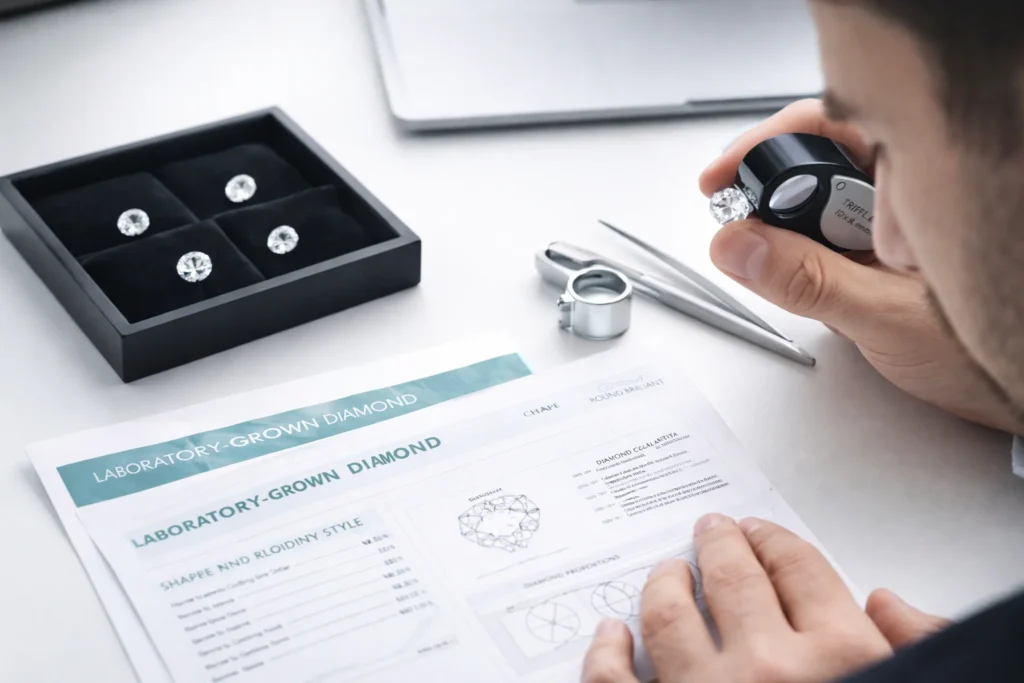
The two most trusted certification bodies in the lab-grown diamond space are IGI (International Gemological Institute) and GIA (Gemological Institute of America). Both certify lab-grown diamonds using the same rigorous standards they apply to mined stones. When evaluating any supplier, certification consistency across all shipments — not just samples — is one of the first things you should verify. Ask to see certificates from multiple orders, not just from the presentation batch.
Trend 3: Understanding CVD vs. HPHT Matters for B2B Buyers
| Feature | CVD | HPHT |
|---|---|---|
| Best for | Larger, colourless stones | Small stones & fancy colours |
| Cost | Generally lower per carat | Higher energy cost |
| Popularity | Fastest growing method globally | Established and widely used |
| Quality range | Very high — D to J colour | Strong in fancy colour range |
Trend 4: Sustainability Claims Are Under Serious Scrutiny
One of the biggest selling points of lab-grown diamonds has always been the sustainability angle — no mining, no land disruption, no conflict sourcing. And while these advantages are real and meaningful, the market has matured enough that buyers and consumers are now asking harder questions. The term for making environmental claims that are not fully backed by evidence is greenwashing, and it is increasingly common in the lab-grown diamond industry as suppliers rush to capitalise on the ethical narrative.
As a B2B buyer, you need to be able to verify the sustainability claims your suppliers make — because your retail customers will eventually ask, and your brand credibility depends on honest answers. The questions worth asking include how energy is sourced for diamond production (renewable versus grid power makes a significant difference to the actual carbon footprint), whether there are third-party audits of the manufacturing process, and whether the supplier has any measurable commitments around waste reduction or water usage. A supplier who genuinely operates sustainably will have documentation. A supplier who cannot answer these questions is likely making marketing claims, not verified commitments.
Trend 5: Customisation and Private Labelling Are Becoming a Differentiator
The B2B buyers who are building the most successful lab-grown diamond businesses are not the ones buying generic, off-the-shelf collections and reselling them. They are the ones working closely with suppliers to develop exclusive product lines — unique cuts, custom settings, branded packaging, and design collaborations that give their retail offering a distinctive identity. This trend toward bespoke and private-label is accelerating, driven by the fact that as more retailers enter the lab-grown space, standard product ranges are starting to look indistinguishable from one another.
If your current supplier only offers a fixed catalogue with no flexibility, that is worth reconsidering. The best lab-grown diamond jewellery suppliers today operate more like manufacturing partners than simple stock vendors. They work with your design team, accommodate custom cuts and sizes, produce under your brand label, and help you build a product range that your competitors cannot easily replicate. This kind of partnership takes more effort to establish upfront, but it creates a durable competitive advantage over time.
Trend 6: India and Surat Are Leading the Global Supply Chain
If you want to understand where the world’s lab-grown diamonds come from, Surat, Gujarat is the answer. India has dominated diamond cutting and polishing for decades, and the country has now made an equally dominant move into lab-grown production. The combination of skilled labour, technical infrastructure, established trade networks, and highly competitive manufacturing costs has made Indian suppliers — particularly those based in Surat — the preferred source for B2B buyers across the USA, Europe, the Middle East, and beyond.
From a supply chain perspective, the post-pandemic period taught B2B buyers an important lesson about the risks of over-dependence on a single supplier or geography. Businesses that had diversified their sourcing were far more resilient when disruptions hit. The smart approach for most B2B owners today is to build relationships with at least two to three suppliers — perhaps a primary Indian supplier for volume and pricing, combined with a secondary supplier from another region for redundancy and range. This protects you from lead time issues, quality inconsistencies, and pricing shocks when one source becomes constrained.
How to Evaluate and Choose the Right Lab-Grown Diamond Jewellery Suppliers
What Good Suppliers Consistently Deliver
Through experience and industry observation, five qualities consistently separate the best lab-grown diamond jewellery suppliers from the rest. First is certification consistency — every stone in every shipment should carry a valid IGI or GIA certificate, not just the samples you reviewed at the start of the relationship. Second is flexibility around minimum order quantities, especially important for B2B buyers who are testing new product lines or entering a new market segment. Rigid, high MOQs with no room for negotiation are a warning sign for a supplier that is not genuinely interested in a long-term partnership.
Third is customisation capability — can the supplier produce bespoke cuts, adjust sizes, work with your design specifications, and offer private labelling? Fourth is reliable lead times with proactive communication. Late deliveries cost you money and damage your relationships with retailers. Ask for documented average lead times and references from existing clients who can speak to their reliability. Fifth is after-sales support — a clear, fair policy for handling defective stones, quality disputes, and replacements is non-negotiable. Any supplier who is vague on this point is telling you something important about how they handle problems.
Red Flags That Should Stop You in Your Tracks
Not every supplier who presents professionally is actually trustworthy or capable. There are several warning signs that should make you pause before placing an order. Suppliers who cannot produce valid certifications for their stones, or who offer certifications from obscure bodies you cannot verify, should be avoided entirely. Similarly, a supplier with no verifiable production facility — no address, no photos, no ability to host a virtual tour — is operating without the transparency that legitimate B2B relationships require.
Pricing that seems dramatically lower than market rate is another warning sign. Significant discounts on lab-grown diamonds are possible through scale and efficiency, but prices that are genuinely too good to be true usually indicate compromised quality, uncertified stones, or worse. Finally, watch out for suppliers who pressure you into large upfront payments before you have established trust, and who cannot provide references from verifiable current clients.
Questions to Ask Before You Commit
Before entering any significant supplier relationship, a focused due diligence conversation is worth the time. Here are the most important questions to raise:
- Which certification bodies do you use consistently — IGI, GIA, or others — and can I see certificates from recent shipments?
- Can I arrange a virtual or in-person tour of your production facility before placing a first order?
- What is your average lead time for a standard order, and how do you communicate when delays occur?
- Do you offer private labelling, bespoke cuts, or custom design collaboration?
- What is your policy for replacing defective or incorrectly graded stones?
- Can you provide references from two or three current B2B clients I can contact directly?
- How is energy sourced for your production — do you use renewable energy, and do you have any third-party environmental certification?
What Real Experience in This Market Actually Shows
The B2B owners who are winning in the lab-grown diamond market right now share a few things in common. They got in early enough to build strong supplier relationships before demand outpaced supply. They invested in training their sales teams to talk confidently about lab-grown product benefits. And they made certification and transparency a non-negotiable standard from day one — which means their brand credibility has held up as the market has matured and consumer scrutiny has increased.
Trade events like JCK Las Vegas and the GJEPC India shows have seen a sharp and sustained rise in lab-grown diamond exhibitors over the last three years. This is no longer a fringe category given a corner of the show floor. It is a central part of the global jewellery trade conversation. Retailers who are still sitting on the fence about stocking lab-grown diamonds are already behind. The ones attending these shows, building supplier relationships, sampling product lines, and developing educated sales teams are setting themselves up for the next five to ten years.
A pattern seen repeatedly across successful B2B accounts illustrates the commercial upside clearly. Mid-sized jewellery retailers who shifted from exclusively stocking mined diamonds to carrying a curated lab-grown range consistently reported meaningful growth in their entry-to-mid price bracket. The reason is straightforward — they could suddenly offer a customer a 1.8-carat or 2-carat stone at a price point where that customer previously could only afford a 0.8 or 1-carat mined diamond. That expanded offering drove new customer acquisition, increased average transaction values, and created a clear point of differentiation from competitors who had not made the shift.
Final Thoughts
The lab-grown diamond market is not a passing trend driven by novelty or hype. It is a fundamental, structural change in how diamonds are produced, valued, and sold — and it is happening at a pace that is accelerating rather than slowing. For B2B owners, this represents one of the most significant commercial opportunities of the decade, provided you approach it with the right level of seriousness and preparation.
The trends are clear: prices have stabilised in a way that creates real margin opportunity; certifications and transparency have become baseline requirements rather than differentiators; sustainability claims matter but need to be verified; customisation and private labelling are becoming the norm among ambitious B2B buyers; and India, particularly Surat, has established itself as the world’s most reliable and cost-competitive source of lab-grown diamonds. Understanding these trends is the first step. Acting on them — by building the right supplier relationships, asking the right questions, and making informed purchasing decisions — is what actually moves the needle for your business.
The right lab-grown diamond jewellery suppliers are not just vendors. They are long-term partners in your growth. Choose them with that lens, and the decisions you make today will pay dividends for years to come. If you are looking for a reliable B2B partner, connect with AuramentWholesale to explore certified lab-grown diamond jewellery options for your business.